Oscar & Opal Osprey are back!

Just a quick update for those of you who may remember my posting on the Naval Academy’s resourceful osprey couple, Opal and Oscar.  (See July 18, 2012)

You may remember that the devoted couple has survived hurricanes and “cherry picker invasions.”  Last summer, after the installation of a surveillance camera next to their nest on their light pole,  they relocated from their grand, 2-story nest to a smaller bungalow-nest just a few light poles away, still overlooking the Severn River and Annapolis harbor. 

Of course, they wintered in the south.  But… they’re back!

 The happy couple seems to be expecting.  They’re sharing nesting duties and putting their home to rights.  And, apparently, their nursery requirements meant a return to the grand, 2-story nest.  This makes 12 years in residence.

And, if I’m not mistaken, their seems to be a young couple taking over the smaller, newer nest just down the way.  I suspect they’re Opal and Oscar’s off-spring.  I doubt that Oscar would tolerate strangers moving in and taking over the nest he and Opal built only last fall.

If the second generation remains, I’ll have to come up with names for the newly weds.

I’ll keep you posted!   

Posted in Nature | Tagged , | 10 Comments

Patience: Human Nature’s Jewel


PATIENCE

Patience is3-2009 001
wider than one
once envisioned,
with ribbons
of rivers
and distant
ranges and
tasks undertaken
and finished
with modest
relish by
natives in their
native dress.
Who would
have guessed
it possible
that waiting
is sustainable—
a place with
its own harvests.
Or that in
time’s fullness
the diamonds
of patience
couldn’t be
distinguished
from the genuine
in brilliance
or hardness.

     –Kay Ryan – The New Yorker, 11/29/99

In the throes of February, I seem to need a refresher course in patience.  Kay Ryan, former Poet Laureate, has crafted a poem that always helps me along that bumpy path toward patience.

What strikes me first is the layout of the poem.  I must be patient to even read and comprehend.  The poem is a ribbon of words that pool into images, and eventually, if I am patient, into thoughts.

My favorite image from the poem – the “harvest” of waiting: patience.  In my audit of coveted character traits, Patience is up at the top of the list,  a precious jewel, a diamond – clear and serene.

I am not a patient person by nature. Patience, such as I have acquired, has been gained through the necessity of  waiting. And if you are over the age of 16, you have learned, just as I have, that waiting  is not a game for beginners. Fledglings can’t wait to fly. babies can’t wait to crawl and walk, and daffodil sprouts can’t wait to bud and bloom. But, like the poem’s speaker, the nest-builders, the doting parents, and the dormant bulbs, I have learned that patience is the harvest of waiting. And waiting  is not easily mastered, at least not for me.

The poem speaks of tasks completed “with modest relish.” Ah, these are my tasks too. I have learned not to fight with myself to  weed or vacuum or scrub… or should I say, I do these perpetual tasks with fewer smothered groans. Everyday tasks have become “native” to me, part of my character, who I am.

And why did the poet choose the metaphor of the diamond for patience? Paradoxically, the beauty of the diamond is its capacity to reflect color and light – its purity, its colorlessness transforms light into luminous incandescence.

If I wait, if I practice patience, I have discovered that what comes my way – the seeming conundrums in my life, can refresh and revive me and, perhaps, others’ as well.  Perhaps I can reflect back some overlooked radiance.  And, really, who cares how long and hard I have struggled to find that stillness within myself?  When I achieve it, can my patience be distinguished from that of any other pilgrim?  the genuine diamond from my woman-made one?

And so, thank you Kay Ryan, and the weeds in my garden, and the dust bunnies beneath my couch.  You do your part and I’ll do mine to acquire a precious quality, Patience.

Adopt the pace of nature; her secret is patience.” – Ralph Waldo Emerson

Posted in Life Lessons, Poetry | 5 Comments

Accolades For the Clean-Up Crew!

What hangs around harbors and fields, clad crisply in white,  cleaning up the flotsam and jetsam of the neighborhood?  What laughs and frolics in the midst of a hard day’s work? What sparkles against the winter sky and settles like a cool breeze on a summer’s beach? 

E

 Perhaps you’ve guessed it – sea gulls. I propose we give a bit more respect to those sometimes pesky, always rowdy, hardworking, independent, strong-willed, helpful birds.

Sure, they leave droppings on our sidewalks and car windows, and sometimes even on our hats. But they also clear the beaches of the dead fish and garbage, eat insect and vermin that harm crops, and entertain children at the seashore with their sassy antics. They glide and swoop and ply the air currents with assurance and abandon.

So, I propose we take a look at a few memorable qualities of our web-footed clean-up crew:

First – There are 44 varieties of gulls. Terns and skimmers are close cousins. Those most common to the Chesapeake region, particularly during the winter, are the:
Black-backed gulls – Big guys with handsome white bodies, black wings tipped in white and snappy, polka-dot tails (when they’re not in breeding.) They have the deep, harsh, slow call. Bonaparte’s gulls – You guessed it, loners with  small, black bills and short, reddish legs. Adept flyers who often pick their food right off the water’s surface.
Herring gulls – Large, brown birds that enjoy a crowd and hang out with his buddies in all the right garbage bins. They prefer fish for dinner, but long ago adapted to sharing their habitat with messy, pesky humans.
Kittiwakes – Small, with black bill and short black legs, rather clumsy, kamikaze-style divers that prefer to winter at sea with their mates. Like the Laughing gull, the Kittiwake takes its name from its distinctive warble.
Laughing gulls – Big, raucous beggars, easily recognized by their call, a demanding guffaw. These are the flocks who take over parking lots and picnic areas where food is plentiful.
Ring-billed gulls – These guys are the ones you see following the farmer’s tractor, lunching on crickets, locust and other pests that could destroy the farmer’s crop.


Second – Gulls have fairly large, muscular bodies, but they adeptly traverse the air currents on land or at sea. Gulls guard their resources, flying no higher and no faster than is necessary to travel great distances or skim the water’s surface while fishing. Gulls fly between 15 and 28 mph on wings spanning from 20 inches to well over five feet. No surprise that their powerful wings have been models for sail makers since ancient times.

Third – Gulls are serially monogamous and great parents. Caring for the eggs and chicks are full-time jobs for both male and female gulls. They share the house/nest work, incubating their two or three eggs until they hatch.  Both Pop and Mom feed and supervise the hatchlings for nine or ten weeks, until the fledglings are ready to take wing. The team work of gull couples pays off;  the survival rate for gull chicks is exceptionally high, over 80%.  They know the value of family and community!

Fourth – Being responsible parents and couples seems to pay off in longevity too. Gulls live to be 20 and even 30 or 35 years old – amazing in the avian kingdom.

Finally – Gulls have adapted to the ever-increasing human population. They’re smart and flexible, able to change with the circumstances. Their noisy calls are actually a fairly complex vocabulary. 

Researchers have found that gulls recognize individual human faces, even after extended periods of time, though I’m not sure why they bother, since we don’t’ seem to share any particular affinity with gulls.

Earlier I mentioned the gulls cousins, terns and skimmers.  You probably won’t see terns until the spring, unless you join them in the southern migration. But I thought I’d take a moment to clear up one point that may have piqued your curiosity: How do you tell a tern from its cousin the gull?

Well, in the air, gulls fly with their heads extended forward while keeping their eyes on the water. Terns bend their necks and heads down toward the water as they fly. On land or floating in the water, you’d probably describe the gulls as husky, muscular fellas with sturdy, short bills.  The terns are small and slender, with black eye-masks and longer bills.

As for the skimmer, you may see a few along the seashore over the winter. You’ll have no trouble recognizing them by their prominent, orange beaks. Their low, strong bodies and wings allow them to skim the surf dragging their lower bills in the water, capturing small fish as they go.  They travel in flocks and perform close-formation acrobatic flying as they ply the surf along the seashore.

English: Laughing gull

 Laughing gull

So, may I suggest that  you take a few minutes to admire the ubiquitous gulls that will surely be wandering around the beaches, foraging in the frozen fields and gardens, and cleaning up the carrion along the roadside too.

Posted in Nature | 5 Comments

A Few of My Favorite Things

Christmas Eve is here, and I am wandering through my memories of Christmases recent and long past.

Among all the visions and emotions twinkling in my heart, two glow steadily brighter  – Christmas baking and trimming the Christmas tree.

These activities, tangential to the occasion, inspire in me the deepest joy. Both activities have remained traditions in my life, for all my years – even accomplished in modest fashion during our year living aboard our little sailboat.  Both baking and trimming taught me patience and perseverance, the joy in sharing even the smallest things.

Baking comes first in my Christmas duo. As girls, my sister and I were set the tasks of shelling nuts and sifting flour, commencing the baking season early in December. Mom would begin her baking with fruitcake and plum pudding preparations, also the cookie doughs that needed to “rest” before they could be coaxed into balls or rolled-out with a beautifully incised rolling pin.

For most of December there were baking projects in various stages of completion tucked away under linen towels and in specially saved tins where they were allowed to rest and rise. And while the yeast, flour and eggs worked their magic, Mom would begin the creation of the simple cookies – lemon bars and brownies, double-chocolate, thumb-print and cut-out cookies. (Mom had perhaps 50 whimsical cookie cutters from which we chose our favorites.) As batches were finished, my sister and I would pack them, between layers of waxed paper, in tins we’d tuck away in the unheated “back room” to await guests.

When friends and relatives paid their calls,  my sister and I would leap into action, choosing from among Mom’s pretty plates then plucking cookies from their tins, arranging the cookies, then bearing them in to the table where Mom served coffee and cookies to our visitors.

What fun it was to set out these pretty and delicious treats, to see our guests laughing and munching our cookies, to hear the compliments and laughter as Mom and the-ladies exchanged observations on the cookie recipes and baking tips.

Cookie baking is still a tradition I enjoy and one I love to share with others, friends young and old. While we may not go to the same lengths as Mom’s baking schedule, it’s fun, no matter how simple the baking project.  And, the cookies always taste delicious, frosted and trimmed by the sticky fingers of those we love.

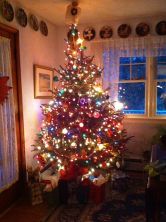
Trimming the Christmas tree is another tradition I cherish. The tree must be fresh – more or less. And the lights must be plentiful. I remember the family trip to the “Christmas tree farm” where Mom would stand back as Daddy and his girls searched for the perfect tree – fat and not-too-tall.  Daddy struggled each year wedging the tree into our metal stand. The process was always fraught with tension as Daddy wrestled  the flailing spruce or fir branches.

Once the tree was more-or-less stabilized, Daddy jammed the strings of lights into place on the branches’ tips.  Fuzzy, black cords held lights the size of small carrots, and those bulbs grew hot quickly. The weight of the lights and the heat they gave off  caused  branches to droop, and if we too quickly commenced decorating, we’d hear ornaments crash or roll off the tree onto the carpet as the tree “settled.”

Now, our lights are tiny, twinkling and cool. The ornaments still roll onto the floor – but now we blame our cats when Santas or snowmen fall, kerplunk, on the hardwood floor.  As the days pass, he fragrance of evergreen fills the house, and shedding needles  settle onto the carpet.

Four, large boxes contain my memories of Christmas trees past, of broken ornaments, odd ribbons and stray strands of tinsel. Most precious, however, are the memories that waft from among the baubles and cardboard.   Here are the sparkling ornaments with beads and ribbon made by my mother and Aunt Irma.  Here are Grandma’s crocheted snowflakes and the paper chains and Christmas trees fashioned by young friends – now grown into men and women with traditions of their own. The pink angel I stitched together in third grade takes her place, as does Aunt Helen’s needlepoint angel. Finally, my flock of birds of glass and feathers and straw settle themselves on the branches – and our tree is complete. Always, some ornaments must be left behind in their boxes to await another Christmas.

Why have these two activities taken on such gravity for me –  the very soul and spirit of Christmas?  Perhaps both cookie baking and tree trimming are the perfect blend of giving and receiving. And, as I think about it, I needn’t tease out which part is the giving and which the receiving – rather, they are woven into a whole, joyful cloth.

I suspect for each of us there are these perfect customs, rituals, activities – those which allow us to give and receive pleasure in equal measure.  It is the spirit of my baking and tree trimming and how the “gifts” – cookies and festive decorations, are shared that fill my heart.

I am reminded of my favorite Quaker adage, “Let your life speak.”  Or, as Daddy always said, “Actions speak louder than words.”

Merry Christmas,and may your New Year be filled with
random kindness and senseless acts of beauty, dear reader.
Let us all honor our favorite things.
Posted in Life Lessons | Tagged , , , , | Leave a comment

The Sky’s the Limit!

We set off yesterday for a drive along the Blue Ridge Mountain’s Skyland Drive in Virginia. The lush autumn day left only a slight haze over the distant mountain ridges above the tidy valleys dotted with farms and villages. Easy to see why they’re called the Blue Ridge Mountains.

I noticed signs along the roadway commemorating the work of the engineers and laborers who carved these crazy, curving roadways and paths out the mountains’ faces and through the deep forests.

The construction of the Skyland Drive and the Blue Ridge Parkway began in 1931, two years into the Great Depression, as part of President Franklin D. Roosevelt‘s WPA “Back to Work” national program.   

WPA workers shoveling plant material
WPA workers shoveling plant material.


How fortunate we are that this beautiful area was preserved for us to enjoy –  the roads clinging to the mountains, stone bridges and low walls holding back the forest – our legacy from the hardworking laborers of that terrible time.

I thought to myself, “We can do this again – make lemonade out of the lemons of economic collapse.”

Our recent election with its broad and deep voting base showed me that we are once again  shouldering our responsibilities – “Let’s get to work.”  Like the men and women who survived the Great Depression of 1929, we too will make the best of a bad situation – the Great Recession of 2008.

We too will  find ways to protect and enrich our planet and our nation, to leave a legacy of strength and beauty for future generations to cherish and admire.

Posted in Life Lessons, Nature | Tagged , , | 6 Comments