from the Fall Issue of UpStART Magazine

VERSE – Other Songs, Other Rooms

By Janice F. Booth  

Photos by Jody Robinson

What happens when you bring together a musician-composer, two journalists, a lawyer-portraitist, abstract expressionist painter, and a designer-artist? Sometimes, you get poetry—that is, if you’re under the spell of Maryland’s tenth poet laureate, Grace Cavalieri. 

Three years ago, Meg Robinson, a renowned composer for the harp, invited 6 women to discuss their creative activities and plans. When it was Cavalieri’s turn to address the group, she talked about her writing—poetry, drama, and historical fiction—and her role as a Maryland poet laureate, teaching people of all ages to create their own poetry. 

“Anyone who is motivated can learn to create poetry,” she assured the gathering. “How about us?” someone asked. So, that day, Cavalieri offered to teach a poetry-writing workshop for any of the gathering’s attendees who might be interested. Six women, myself included, signed up. And from there, it has been quite a ride. 

Cavalieri set the tone for the workshops by hosting our little group. She fed us and led us through as we wrote our first poems. Within a few months, however, our workshop, “Artists Who Are Poets,” was faced with the social restrictions that came with the COVID-19 pandemic. We persevered, continuing the workshop online. Since that challenging beginning, we have faithfully Zoomed with Cavalieri twice a month. Before each gathering, we each write a poem in a particular style or on a particular topic, based on Cavalieri’s prompt. 

After 16 months and 32 workshop sessions, our leader insisted that it was time to jump in the deep end. We gathered our poems, discussed which were strongest and most accessible to a general audience, and selected over 70 original poems to publish. The collection’s title, The Song In the Room: Six Women Poets, came to us from Robinson, the musician who had brought us together. She observed that when she was composing with other musicians, the composition was referred to as the “song in the room.”  

There are lots of attempts to define poetry, and most or all the definitions include two words: beauty and meaning. But even those two concepts are debated. What is central to Cavalieri’s poetry and her teaching is the bedrock of truth—going deep into the heart of an idea or experience to find, as Cavalieri says, your truth. One of Cavalieri’s poems that address this core of truth is titled “This Poem Is Asking For Your Love.” Here is an excerpt:

This poem is not usually like this 

I don’t know what came over it

It’s mostly violet under the sun 

with a large yellow parasol 

and a pond with a center that never freezes 

I swear I had no idea 

I’m so used to trees of hearts 

and cherries within its branches 

I can’t imagine 

what woke this poem up 

with a truth I never wanted . . .

It had no idea what trouble could come 

from this so I wrote it 

then I ran from it 

now I can erase it 

to show I never needed it after all 

because don’t you know, Poem, 

if you have to ask for something 

it’s no gift.

We six intrepid women—cautious at first but slowly building trust—have written our truth, often using specific poetic forms such as the French villanelle, which involves repeated lines and rhymes; an Arabic ghazal, with complex line repetition; the Italian-Petrarchan and English-Shakespearean sonnets of 14 lines on a love theme; the spare and beautiful Japanese haiku; and a Greek elegy lamenting what is lost. It has been fun and challenging, diving into poetry from such varied cultures. These wide-ranging forms have deepened our understanding of other cultures and how they express truth and beauty poetically. 

Truth emerges in many guises in our poetry. After some winter weeks spent on Florida’s Sanibel Island, Natalie Canavor, author of several texts on business communications, NYU professor, and award-winning journalist for the New York Times, wrote “Beach Sonnet,” which reflects upon the delicate seashell found in abundance on Sanibel’s beaches. Here is part of it:

We snatch the most flawless from beds of sand

To ponder beauty . . . the meaning of art . . .

Hold the perfect small miracles in hand

And feel a joyful upswing of heart.

But we decline to consider the sculptor

Unless we find the alien creature inside.

Then we recoil from its slithery horror,

Our blackest nightmare personified.

Is this the inexorable end all along?

Throw out the singer, treasure the song?

She chose to write her musing on seashells as a sonnet, a poem on some facet of love. Canavor, reflecting on what she has learned and how her understanding of the poetic voice has deepened, says: “I learned that the magic of poetry is in the space between words; what you don’t say is just as important as what you do say.”

Each of the group’s participants is active in the world, exceling and experienced in challenging careers. Each has made homes and raised families. We were surprised to find that the skills and insights from our lives naturally lend themselves to poetic forms. Carole Falk, an abstract expressionist painter whose works hang in corporate offices and private homes, is an authority on Asian art and writes about art. She experiences language in the context of painting. “Poetry is an act of sensual meditation—painting with words, matching the mind with clarity and color,” she says. Her poem “True or Not” captures what her artistic sensibility perceives:

Can a river be lonely?

Can waves yearn to hold last summer’s ducks;

can the rhythm be lost when no one is looking?

Barnacles amass on a piling—

growing, eroding without anyone noting.

Rocks lay unmoved, gathering algae while

grasses grow unchecked at water’s edge

and sway to an unheard song.

I hear the river sigh.

Dona B. Rudderow operates her own commercial arts business, DONACO Design Communication, and is also recognized as a visual artist Her children’s literature series Adventures to Awesome has been used in curriculums nationally. She brings all of this and her world travels into her writing. “Poetry has opened my eyes, heart, and soul to my world, and all that is around me,” she says. Her poem “Possibilities,” takes the reader to the edge:

lying in the Arctic snow,

gazing up,

at the crackling Northern Lights . . . 

silence is before me,

so meager a being I am,

laying under the universe before me . . . 

yet empowered,

discovering strength,

within me!

Sandy Jackson Cohen, formerly a lawyer with the Maryland Office of the Attorney General, is a widely acclaimed portrait artist affiliated with Maryland Hall for the Creative Arts. Cohen has taught law, farmed blueberries, and avidly defends the waters and shoreline of the Chesapeake Bay. “Poetry offers ways to artfully express authenticity–so that one’s truth can sing. Sometimes, creating a poem helps in finding that truth,” she says. Cohen’s poem “Haven” illustrates this discovery of truth as she thinks about life both wild and free along the Chesapeake Bay. Here is an excerpt:

This is their place –

the free, the wild ones.

Here I stay by their grace

to be renewed when I come . . .

You wonder that I say I miss them

when they’re called by instinct to depart.

True – I’ve never touched or held them.

Yet free creatures swell my heart.

These foxes, eagles, flocks of swans –

this place of pause from the race we’re on.

Robinson, the spark that set us all afire by bringing us together, writes, performs, records her own songs, and leads an online support group. “Writing poetry is both similar to and different from writing song lyrics,” she reflects. “When I write poetry, I am creating a different kind of music. What works in a song may not work as a poem. But devices like metaphor, simile, and personification are useful in both lyrics and poetry.” An effective example of what Robinson is describing is her poem “People Are Museums.” Here are the first two stanzas; you’ll recognize this poem’s metaphor:

People are museums.

They are collections.

They are special exhibits

of emotions and ideas and beliefs . . .

People are displays that can be seen at certain times.

When the signs says “Open.”

When you have a ticket to enter,

They sometimes give tours,

When they want to let you through the door . . .

I have learned so much from this group of poets, and they influence the poetry I write. I have found that, while reading poetry has always been a thought-provoking pleasure, it also helps me to see perspectives that I might have overlooked or ignored. When I write a poem, I step out of my comfort zone and move about in the joys and sorrows, and fears and delights of the unexpected. In my poem “Dark Places,” I acknowledge the experience of discovering what I have hidden. Here is an excerpt:

Have you a drawer that holds who-knows-what?

A seldom opened, shadowed, dusty place

to toss life’s odds-and-ends, and keys to rooms now shut?

I’ve found forgotten fragments, talismans to bring me luck.

Faded memories rise unbidden, and time could not erase

what’s left inside my drawer that holds who-knows-what . . .

Why clear the shards, untie the knots,

forgive myself and others, in each case?

I have a drawer that holds who-knows-what,

and I alone keep keys to rooms now shut.

This poem in its entirety is a villanelle that relies on line repetition. I find the repeating of certain lines almost hypnotic, taking me, and perhaps my reader, into those forgotten, dusty recesses of my life. 

Truth, authenticity, veracity–these are the measures of our work. We’re always leaning into new challenges, new opportunities, and new discoveries. And that is where our six, disparate lives converge. We have all gone deeper into our histories, our loves, and our losses, and we have come through it stronger and wiser. Poetry shows us the richness of sharing our truth and creating beauty from pain and joy, sometimes in equal parts. We find ourselves. All this revelatory work takes courage. 

Each of us has begun a new, exciting profession, one that will never end. As our mentor Cavalieri says, “To be awake in the world, and then to write it, is to live twice. We are the lucky ones.”   █

For more information about The Song In the Room:
Six Women Poets, visit https://amzn.to/3bb78bw.

Posted in Uncategorized | 1 Comment

Attention Must Be Paid!

A Must-See Exhibit of Botanical Drawings by Anna Harding

BY JANICE F. BOOTH 

Anna Harding’s exhibition is titled Wake Up: We Need Everybody.


Images courtesy Anna Harding

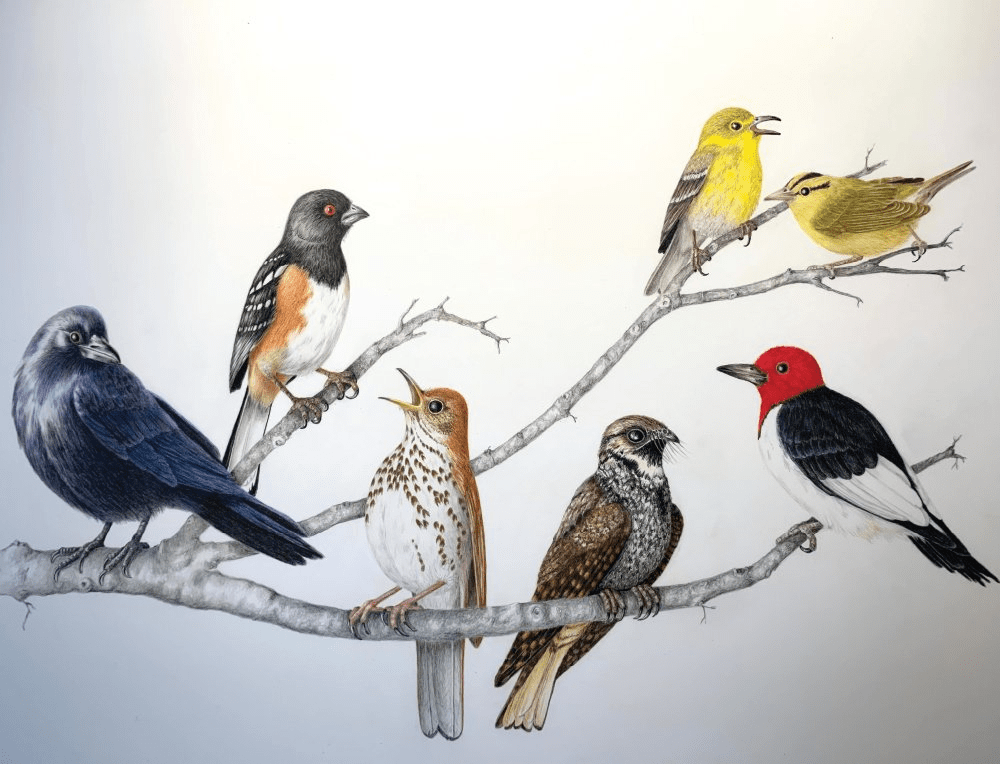
Backyard Birds 2 The branch, from left to right: Fish Crow, Rufous Towhee, Wood Thrush, Whippoorwill, Pine Warbler, Worm-eating Warbler, and Red-headed Woodpecker. The Audubon Soc. lists all of these bird species as at risk of extinction due to climate change.

Art2.jpg

Images courtesy Anna Harding

Do you remember coming upon a Bog Turtle trundling across your path when you were a child? Or the sound of a Barking Tree Frog as you lay on the grass looking up at the stars? Carolina Buttercups and Purple Milkweed once dotted local meadows. And there was excitement when coming upon a Yellow-fringed Orchid or Wood Lilies when wandering along shady trails. These and many other lovely creatures and plants need our protection and help if they are to regain and retain their places in Maryland’s natural world, waiting to be admired by future generations as they too wander the wild places in our state.

Expand

Images courtesy Anna Harding

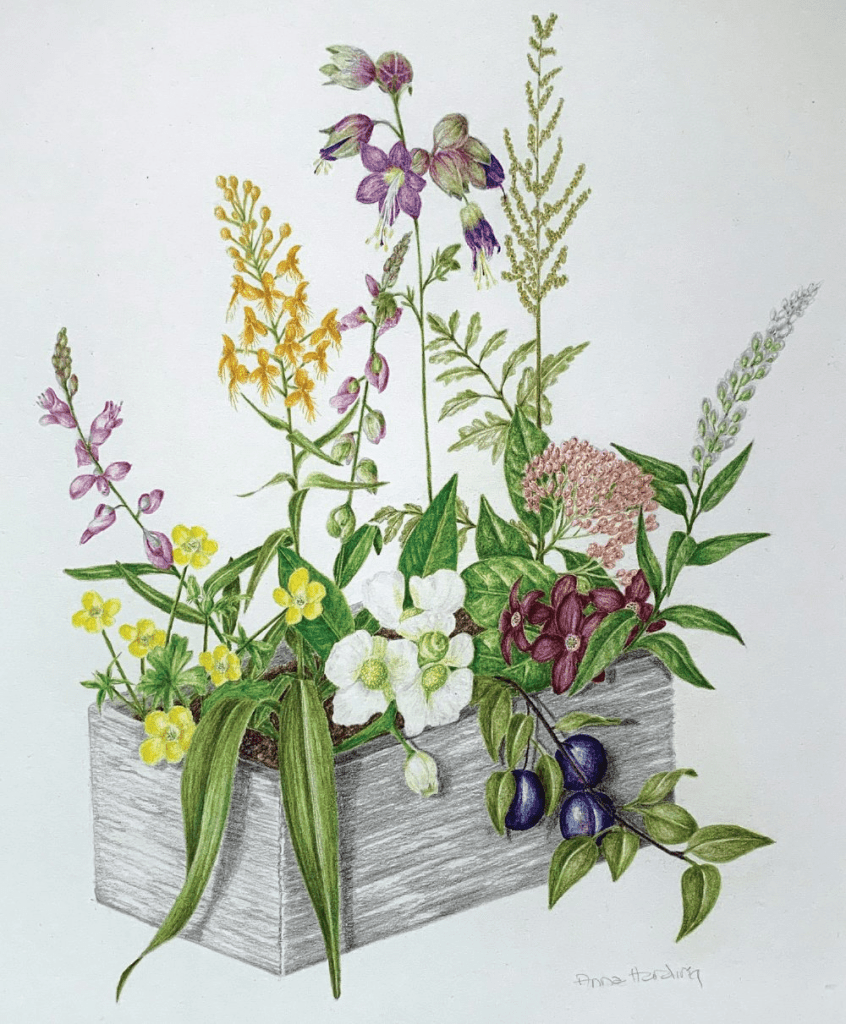
Where Have All These Flowers Gone? The wooden planter contains Carolina Buttercup, Racemed Milkwort, Yellow-fringed Orchid, Sessile-fruited Arrowhead, Bog Jacob’s Ladder, Allegheny Plum, Carolina Milkvine, Blunt-lobed Grape Fern, Marsh Fleabane, Camphorweed, and Seneca Snakeroot. All of these flowers are endangered or threatened.

Images courtesy Anna Harding

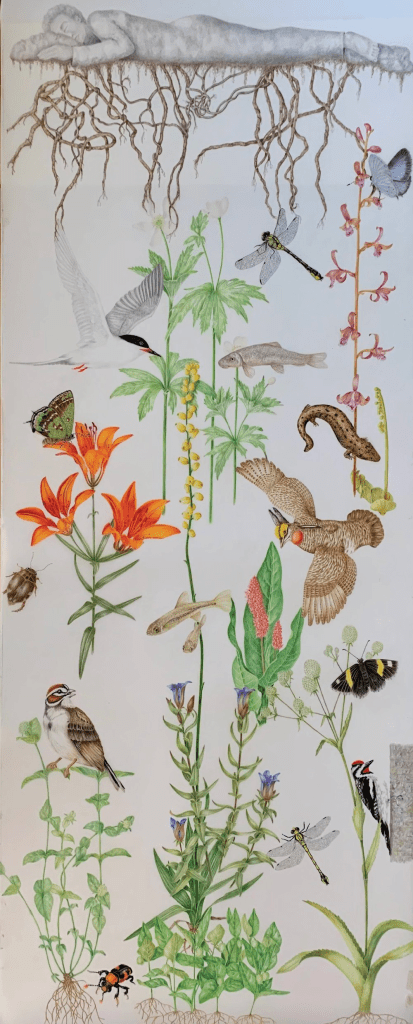
Wake Up This eponymous piece, with the supine figure of a human at the top, measures 17” x 42.” The drawing includes plants, birds, dragonflies, salamanders, fish, butterflies, and beetles with evocative names like Curly-heads, Rattlesnake-master, Lark Sparrow, Roseate Tern, Skillet Clubtail Dragonfly, Common Mudpuppy, Dusky Azure, and Schwarz Diving Beetle. (What’s not to love?)

“I am hoping to educate people on the shocking reality [of rapidly disappearing flora and fauna.] We can still do something [to rescue these beauties] if we try,” says botanical artist Anna Harding. She has spent the last two-plus years creating beautiful and eloquent drawings of the animals, insects, amphibians, and plants that are disappearing from Maryland’s woods, meadows, waterways, and shorelines. And now, these works of art are on exhibit at Adkins Arboretum in Ridgely, Maryland.

The 25 drawings in the exhibit, executed in graphite and colored pencil, are all of living things that shared our world but are now endangered, threatened, or extinct according to Maryland’s Department of Natural Resources (DNR). Maryland’s DNR website is a valuable, if disheartening, resource that lists plants and animals of the state that need conservation efforts. Those lists became a useful resource as Harding prepared for and executed her drawings.

Harding is a member of the Working Artists Forum in Talbot County. She founded the Botanical Art League of the Eastern Shore and teaches a monthly class at Adkins Arboretum. Reflecting on her work and the creatures she has come to know so intimately through her art, Harding observes, “I am hoping the viewer will realize that all creatures exist with a role to play that is part of the bigger picture indicating the health of the environment here on the Eastern Shore, our home.”

Art5.jpg

Images courtesy Anna Harding

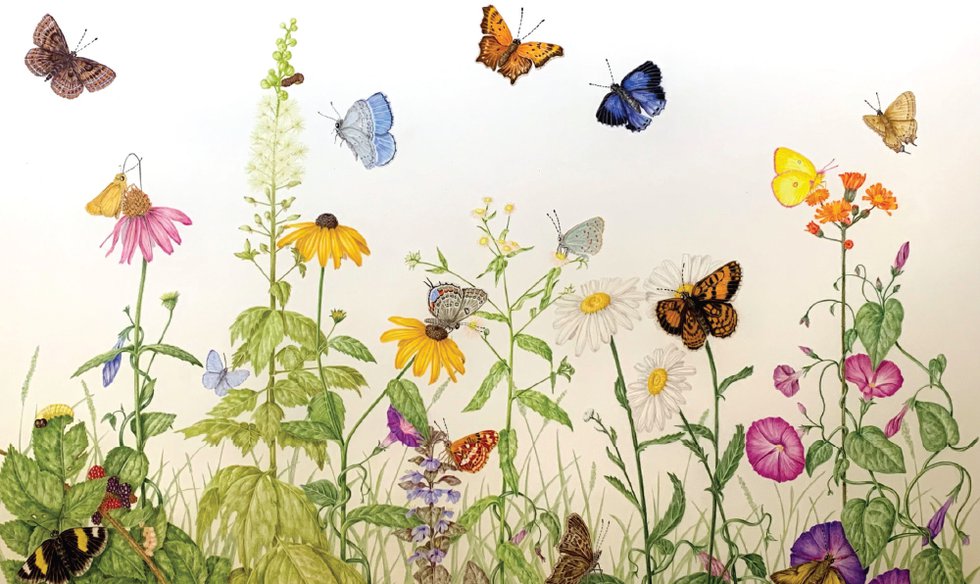
Ephemeral Beauty These butterflies and their host and/or nectar plants include: In the air: Northern Metalmark, Appalachian Blue, Gray Comma. Early Hairstreak, and Edward’s Hairstreak butterflies. Settled on plants: Delaware Skipper, Golden-banded Skipper, Edward’s Hairstreak, Silver-bordered Fritillary, Early Hairstreak, Gray Comma, Harris’s Checkerspot, Pink-edged Sulphur.

BY JANICE F. BOOTH

AUG. 15, 2022

Posted in Nature | 1 Comment

A group reading from The Song In the Room

You may be interested in hearing readings from the poems in our collection. Each of us reads several poems, and we’re in alphabetical order, so my reading comes first after the introduction. https://youtu.be/7nQqEv5X3Jc

Posted in Uncategorized | Leave a comment

Keeping Your Garden in Focus Through a Camera’s Eye

BY JANICE F. BOOTH 

APR. 06, 2022 What’s Up? Annapolis & What’s Up? Eastern Shore

cameras-eye.jpg
cameras-eye2.jpg

If you’re like me, your smart phone is filled with pictures of the dog with her new toy, the kids at the beach, and so much more. But, if you look back over the last year, or even two or three years, how many pictures do you have of your garden in its varied splendor? The splash of daffodils along the side fence? Those crazy petunias that kept blooming for months? Your spindly oak sapling that’s getting bigger and lovelier each year? 

With these objectives and probably many others that you can think of, here are some handy tips for making your garden’s photographs particularly lovely and useful.

First, let me share a few photographer’s tips that help get the best photo in the moment. “Good lighting” for outdoor photography is not bright sunlight. Overcast skies or early morning and late afternoon are better for pictures. The muted, softer light produces a better image. Hint: If you plan ahead, take a sheet of tin foil with you. You may be able to set it up as a reflector onto particular blooms for dramatic effect.

Frame your picture. Choose a particular plant or bloom as your focal point. Hold your finger on the screen for just a few seconds, and your phone’s camera will focus for you. Think about textures in a photograph. Try to show the fuzziness of a stem, the rough bark or feathery leaf. Look at the structure of plants as well as the form. Perhaps the unusual angle of a stem or branch, or the contrast of a vining plant with a lush one will make a more interesting photo. 

Here are some tips for artistic pictures to be used later for cards and collages. Plan to take a lot of pictures; don’t limit yourself to one or two shots. You can later discard the images that don’t meet your expectations. Take pictures from different angles: can you go to an upper story or balcony and shoot down into your garden? How about a different bird’s eye view; lie down and shoot pictures up among the rose bushes or through the lavender plants?

Next, using your photographs as a record to help you record changes and areas. Consider a telescoping series of photos. Begin with a close-up of one plant, then move the lens focus to include those plants that surround the one plant. Then, capture the flower bed or portion of the garden. And finally, take a more panoramic photo that sets that single plant and its neighboring plants in the larger context of the garden. 

Create a seasonal collage. Choose some key plants—perhaps even draw a little map so you remember where you are focusing each set of pictures—perhaps one series from the deck looking out, another series from the garden gate looking in. Then, take a few pictures from each vantage point during each season; you might even decide to take the pictures once-a-month. Next winter, as you shoot your last series, you can arrange all the photos from each vantage point, and note the particular beauty of that season or month. 

Expand

cameras-eye3.jpg

You may use your photos to monitor a new plant you’ve just added to your garden. Initially, take pictures of the plant at different times of day so you can understand how light hits the plant. Then, take photos week-by-week or month-by-month as it flourishes in your garden. And, if it doesn’t flourish, you’ll have the images to share with a fellow gardener or master gardener who can help you figure out how to treat the plant. 

Finally, your garden photographs provide a handy reminder or to-do list. Jotting down a note-to-self on a scrap of paper, a seed packet, or even a diary you carry with you, may not work out well. I have often searched through my little note pad trying to find my note about moving that Japonica or when I’d fertilized that lovely Bleeding Heart near the front door. Using pictures as reminders may work better.

Make folders on your smart phone photo application labeled with “Reminders for Spring,” “Reminders for Summer,” etc. Then, when you see that pink azalea needs to be moved after it stops blooming, or the mums will have to be pruned in early June for a better shape in September, take pictures and drop them into the “Summer” folder. If you’re like me, you always have your phone in your jeans’ pocket, so you can grab it for a photograph. A quick snap of the camera is much easier than pen and paper in the garden.

You might also create a folder titled “Inspiration.” Here’s where you’ll put those photos you took at a public garden of a cluster of Coreopsis and Cornflowers or the pretty Hibiscus you pass on your morning walk. The phone-camera will even date the pictures, so when you go into your inspiration folder, you can see exactly when you captured these lovelies at their best. 

As always, you’ll come up with more ideas that suit your needs as you begin to think of your smart phone’s camera as another essential gardening tool. 

Garden photos can serve many purposes. Among them are:

  • A fresh viewpoint on your garden—both the familiar and the overlooked beauty there.
  • A record of the growth and expansion of particular plants and trees—throughout the year and over the years.
  • A reminder of plants that need to be moved or trimmed or receive first aid at some later date. 
  • A source of beauty to use as notecards, greeting cards, and other original creations. 
Posted in Uncategorized | Leave a comment

Magical Distractions: Feeling Refreshed in Your Garden

What’s Up? Magazine, July 2022

Garden1.jpg

What a glorious time of year in our gardens. Last year’s plantings and pruning, and our early spring feeding and watering, are repaying us with flourishing plants and voluptuous blooms. The hammock and the chaise are calling us; Relax, put your feet up. (Maybe you’re doing so as you read this). Of course, we understand summer also brings heat and humidity, even in our gardens, and on our decks and patios. But let me offer, at least, a partial remedy for summer’s sticky heat. I suggest you apply a bit of magic, a few tricks that may enable you and your family to laze about in the garden even in the heat of July and August. We can take a tip from successful magicians. They distract their audiences, redirecting attention from what is not to be seen—or in our case, felt. 

Here are a few magical distractions

Expand

Garden2.jpg

Shade

 is an important part of feeling cooler. It may be a little late to plant a shade tree in your garden this summer, but there are other options. Consider how the sun reaches your deck or patio. When do these areas get the most use by you and your guests—morning, midday, sunset? How can you divert attention from the sun’s heat? Perhaps install a pergola or an arbor, depending on how much space you have. A pergola is customarily an arched frame on which vines are trained or plants are hung. You could have one installed right now and for this first summer, rely on hanging plants to create the illusion of vining, while ivy or wisteria or clematis vines are planted and trained for a shady show next summer. The idea is to distract from the heat of the day with visions of green and an impression of a shady glade. If you’d like a more modern, pared-down source of shade, install a shade sail. It can be rectangular or square, and usually white or cream color to reflect the sun. Be sure the sail is securely anchored against the winds of summer storms. One advantage to the shade sail—it can be relocated to provide the best shade. While it won’t evoke a shady glade, it may offer thoughts of sails on the Bay slipping gracefully across the waves. See how quickly our thoughts float away from the heat and humidity? 

Expand

Garden3.jpg

Air Flow 

magically distracts us from the weight of Maryland’s humid air. Just think about a gentle breeze across your face and you begin to feel cooler. A few quiet floor and pedestal fans can create that same feeling, working their magic. If you place a low fan among or behind a few potted plants, you’ll hardly notice the artifice. Since you’ll need electricity, think about adding an outdoor outlet or two, if you don’t have one available. Be sure the fans you choose are quiet; it’s difficult to chat or read if there’s a roaring or rumbling motor nearby. Pedestal fans can usually be set to oscillate and setting one or two of these fans to turn slowly along the edge of your seating area works wonders. Not only will the fans provide moving, cooling air, but they will also discourage flies, mosquitoes, and gnats from joining you in your shady retreat. Another little trick: set the fans on simple timers to come on when you’re likely to be on the patio and turn off without your having to think about them. One caution: If you haven’t bought outdoor, waterproof fans, have a few plastic waste bags available to cover the fans if rain is expected. The motors won’t take kindly to being soaked. 

Garden4.jpg

Cool Things 

to redirect our body’s thermostats work wonders too. Consider investing in a few pet cooling-mats. You’ll find them on-line and in some pet stores. They’re available in a variety of sizes. The mats are filled with water, air, or gel and absorb body heat while creating a cool feeling. Place them on loungers and chairs and find yourself impervious to summer’s humid heat. Watch out, however, not to sit down on your cat or dog, who might have preempted your use of a cooling mat. Another “cool thing” is a mister or mister-fan. One or several misters can be installed on your deck or patio, camouflaged behind plants or trees, or attached to awnings or roof beams. Misters work by spraying water molecules that change from liquid to gas or mist. I know, you’re probably thinking, Isn’t there already too much humidity? Why add more? The difference with a mister is that the process of turning water drops into mist, a gas, takes energy/heat, which is pulled out of the air, thereby lowering the ambient temperature. There are do-it-yourself kits, but I recommend you get a reliable plumber to install your misters, including the pump to run them. Once properly installed, there’s very little maintenance, and if properly winterized, the misters will continue to work for years. If you’re wondering about the ecological cost, the power to run a mister is far less than what is needed to keep an air conditioner humming. Oh, almost forgot: you can have your misters set up to spray a mixture of water and natural-botanical mosquito repellants, essence of marigold, for example. There’ll be no mosquitos bothering you all summer long—or at least when you use the mister fairly regularly—about 2–3 times per day.

Expand

Garden5.jpg

Water Features 

are a tried-and-true means of distracting us from hot, humid temperatures. We all long for a quiet beach and the sound of waves lapping at our toes. Add a little fountain to your patio; set it up in a shady corner, if possible, and you’ll have songbirds and butterflies as regular guests. You’ll also enjoy the sound of the water as it tumbles down. Small fountains are electric and usually plug in at an ordinary household outlet. Out caution though, you may have to add water daily. If it goes dry, the pump motor can burn out. 

These are just a few simple ways to make your summer garden as delightful as possible. Work your own magic. 

Posted in Nature, Published articles, Uncategorized | 1 Comment