Attention Must Be Paid!

A Must-See Exhibit of Botanical Drawings by Anna Harding

BY JANICE F. BOOTH 

Anna Harding’s exhibition is titled Wake Up: We Need Everybody.


Images courtesy Anna Harding

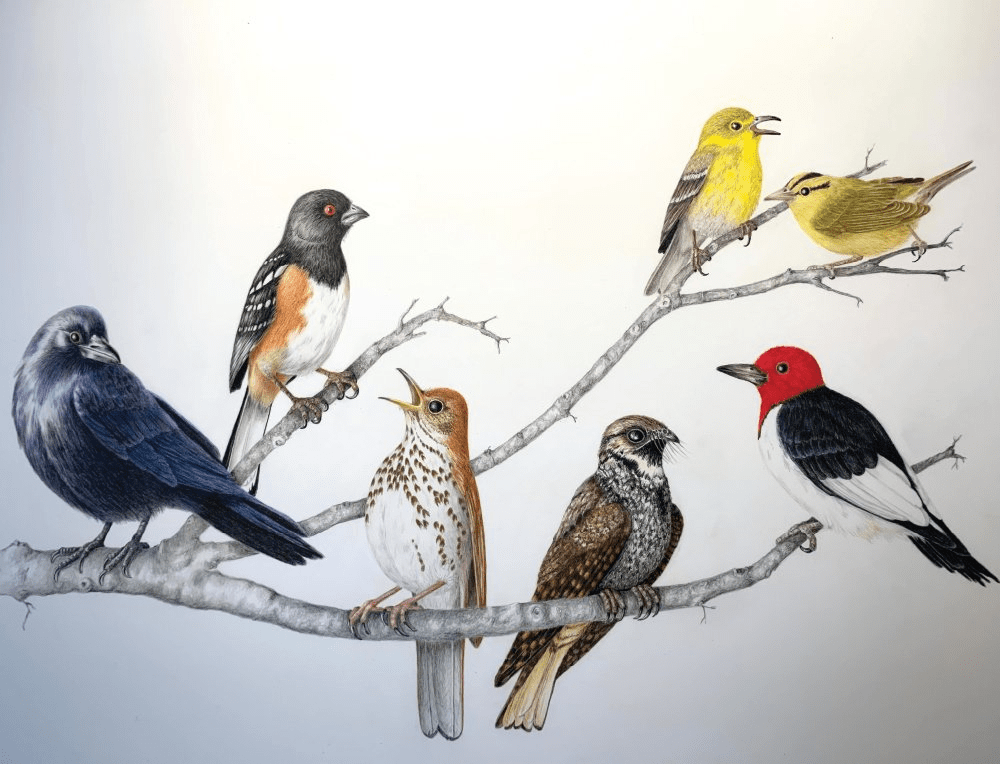
Backyard Birds 2 The branch, from left to right: Fish Crow, Rufous Towhee, Wood Thrush, Whippoorwill, Pine Warbler, Worm-eating Warbler, and Red-headed Woodpecker. The Audubon Soc. lists all of these bird species as at risk of extinction due to climate change.

Art2.jpg

Images courtesy Anna Harding

Do you remember coming upon a Bog Turtle trundling across your path when you were a child? Or the sound of a Barking Tree Frog as you lay on the grass looking up at the stars? Carolina Buttercups and Purple Milkweed once dotted local meadows. And there was excitement when coming upon a Yellow-fringed Orchid or Wood Lilies when wandering along shady trails. These and many other lovely creatures and plants need our protection and help if they are to regain and retain their places in Maryland’s natural world, waiting to be admired by future generations as they too wander the wild places in our state.
Expand

Images courtesy Anna Harding

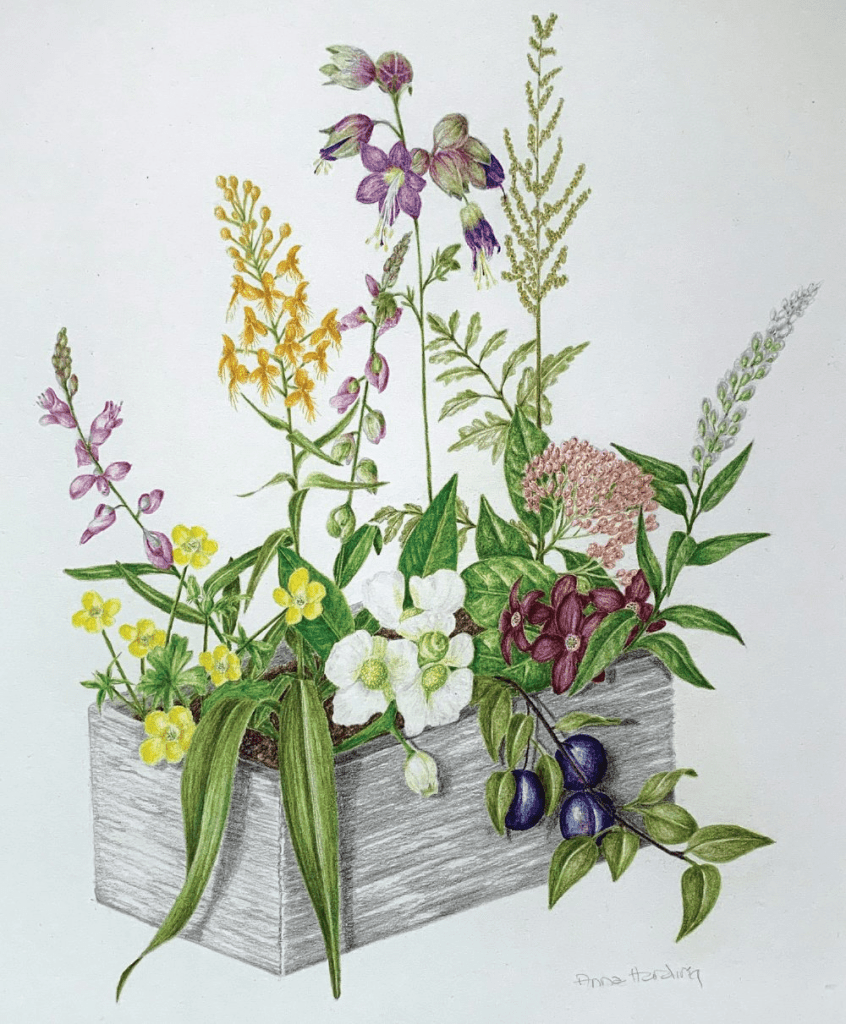
Where Have All These Flowers Gone? The wooden planter contains Carolina Buttercup, Racemed Milkwort, Yellow-fringed Orchid, Sessile-fruited Arrowhead, Bog Jacob’s Ladder, Allegheny Plum, Carolina Milkvine, Blunt-lobed Grape Fern, Marsh Fleabane, Camphorweed, and Seneca Snakeroot. All of these flowers are endangered or threatened.

Images courtesy Anna Harding

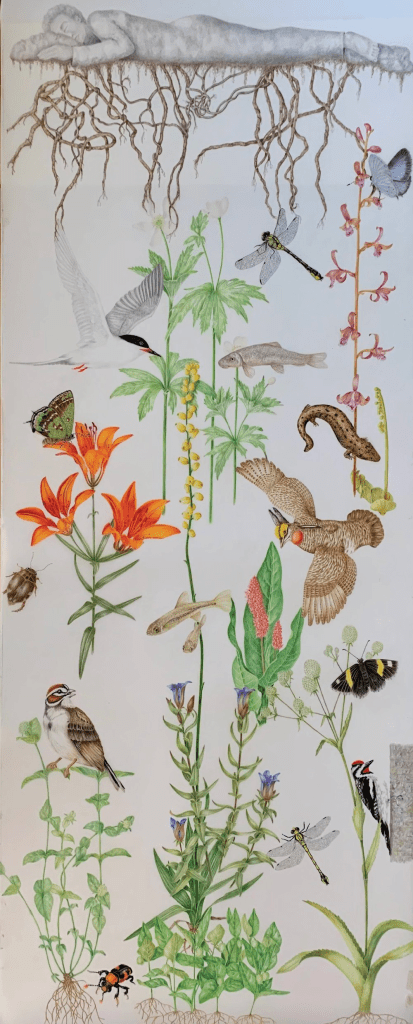
Wake Up This eponymous piece, with the supine figure of a human at the top, measures 17” x 42.” The drawing includes plants, birds, dragonflies, salamanders, fish, butterflies, and beetles with evocative names like Curly-heads, Rattlesnake-master, Lark Sparrow, Roseate Tern, Skillet Clubtail Dragonfly, Common Mudpuppy, Dusky Azure, and Schwarz Diving Beetle. (What’s not to love?)
“I am hoping to educate people on the shocking reality [of rapidly disappearing flora and fauna.] We can still do something [to rescue these beauties] if we try,” says botanical artist Anna Harding. She has spent the last two-plus years creating beautiful and eloquent drawings of the animals, insects, amphibians, and plants that are disappearing from Maryland’s woods, meadows, waterways, and shorelines. And now, these works of art are on exhibit at Adkins Arboretum in Ridgely, Maryland.

The 25 drawings in the exhibit, executed in graphite and colored pencil, are all of living things that shared our world but are now endangered, threatened, or extinct according to Maryland’s Department of Natural Resources (DNR). Maryland’s DNR website is a valuable, if disheartening, resource that lists plants and animals of the state that need conservation efforts. Those lists became a useful resource as Harding prepared for and executed her drawings.

Harding is a member of the Working Artists Forum in Talbot County. She founded the Botanical Art League of the Eastern Shore and teaches a monthly class at Adkins Arboretum. Reflecting on her work and the creatures she has come to know so intimately through her art, Harding observes, “I am hoping the viewer will realize that all creatures exist with a role to play that is part of the bigger picture indicating the health of the environment here on the Eastern Shore, our home.”
Art5.jpg

Images courtesy Anna Harding

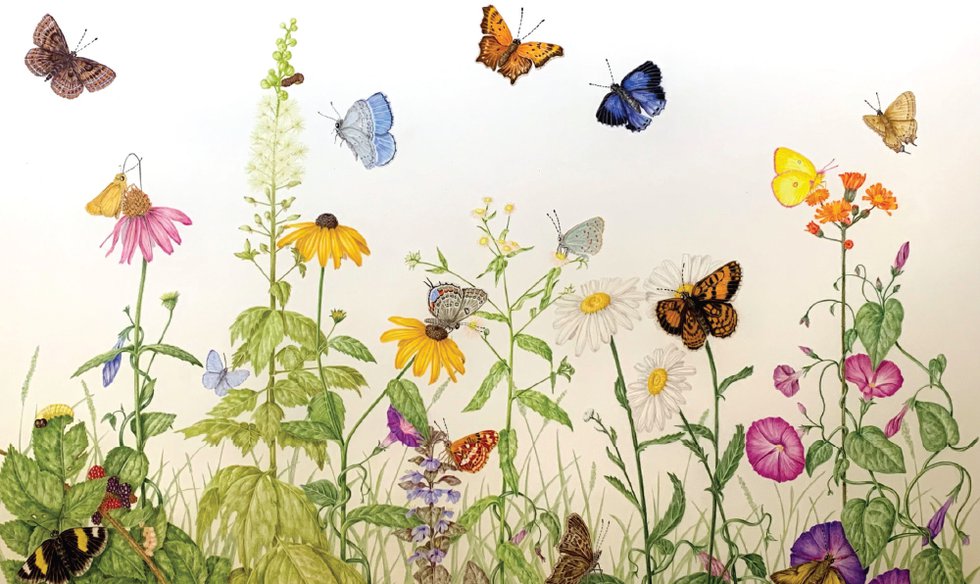
Ephemeral Beauty These butterflies and their host and/or nectar plants include: In the air: Northern Metalmark, Appalachian Blue, Gray Comma. Early Hairstreak, and Edward’s Hairstreak butterflies. Settled on plants: Delaware Skipper, Golden-banded Skipper, Edward’s Hairstreak, Silver-bordered Fritillary, Early Hairstreak, Gray Comma, Harris’s Checkerspot, Pink-edged Sulphur.

BY JANICE F. BOOTH

AUG. 15, 2022

Posted in Nature | 1 Comment

A group reading from The Song In the Room

You may be interested in hearing readings from the poems in our collection. Each of us reads several poems, and we’re in alphabetical order, so my reading comes first after the introduction. https://youtu.be/7nQqEv5X3Jc

Posted in Uncategorized | Leave a comment

Keeping Your Garden in Focus Through a Camera’s Eye

BY JANICE F. BOOTH 

APR. 06, 2022 What’s Up? Annapolis & What’s Up? Eastern Shore

cameras-eye.jpg
cameras-eye2.jpg

If you’re like me, your smart phone is filled with pictures of the dog with her new toy, the kids at the beach, and so much more. But, if you look back over the last year, or even two or three years, how many pictures do you have of your garden in its varied splendor? The splash of daffodils along the side fence? Those crazy petunias that kept blooming for months? Your spindly oak sapling that’s getting bigger and lovelier each year? 

With these objectives and probably many others that you can think of, here are some handy tips for making your garden’s photographs particularly lovely and useful.

First, let me share a few photographer’s tips that help get the best photo in the moment. “Good lighting” for outdoor photography is not bright sunlight. Overcast skies or early morning and late afternoon are better for pictures. The muted, softer light produces a better image. Hint: If you plan ahead, take a sheet of tin foil with you. You may be able to set it up as a reflector onto particular blooms for dramatic effect.

Frame your picture. Choose a particular plant or bloom as your focal point. Hold your finger on the screen for just a few seconds, and your phone’s camera will focus for you. Think about textures in a photograph. Try to show the fuzziness of a stem, the rough bark or feathery leaf. Look at the structure of plants as well as the form. Perhaps the unusual angle of a stem or branch, or the contrast of a vining plant with a lush one will make a more interesting photo. 

Here are some tips for artistic pictures to be used later for cards and collages. Plan to take a lot of pictures; don’t limit yourself to one or two shots. You can later discard the images that don’t meet your expectations. Take pictures from different angles: can you go to an upper story or balcony and shoot down into your garden? How about a different bird’s eye view; lie down and shoot pictures up among the rose bushes or through the lavender plants?

Next, using your photographs as a record to help you record changes and areas. Consider a telescoping series of photos. Begin with a close-up of one plant, then move the lens focus to include those plants that surround the one plant. Then, capture the flower bed or portion of the garden. And finally, take a more panoramic photo that sets that single plant and its neighboring plants in the larger context of the garden. 

Create a seasonal collage. Choose some key plants—perhaps even draw a little map so you remember where you are focusing each set of pictures—perhaps one series from the deck looking out, another series from the garden gate looking in. Then, take a few pictures from each vantage point during each season; you might even decide to take the pictures once-a-month. Next winter, as you shoot your last series, you can arrange all the photos from each vantage point, and note the particular beauty of that season or month. 

Expand

cameras-eye3.jpg

You may use your photos to monitor a new plant you’ve just added to your garden. Initially, take pictures of the plant at different times of day so you can understand how light hits the plant. Then, take photos week-by-week or month-by-month as it flourishes in your garden. And, if it doesn’t flourish, you’ll have the images to share with a fellow gardener or master gardener who can help you figure out how to treat the plant. 

Finally, your garden photographs provide a handy reminder or to-do list. Jotting down a note-to-self on a scrap of paper, a seed packet, or even a diary you carry with you, may not work out well. I have often searched through my little note pad trying to find my note about moving that Japonica or when I’d fertilized that lovely Bleeding Heart near the front door. Using pictures as reminders may work better.

Make folders on your smart phone photo application labeled with “Reminders for Spring,” “Reminders for Summer,” etc. Then, when you see that pink azalea needs to be moved after it stops blooming, or the mums will have to be pruned in early June for a better shape in September, take pictures and drop them into the “Summer” folder. If you’re like me, you always have your phone in your jeans’ pocket, so you can grab it for a photograph. A quick snap of the camera is much easier than pen and paper in the garden.

You might also create a folder titled “Inspiration.” Here’s where you’ll put those photos you took at a public garden of a cluster of Coreopsis and Cornflowers or the pretty Hibiscus you pass on your morning walk. The phone-camera will even date the pictures, so when you go into your inspiration folder, you can see exactly when you captured these lovelies at their best. 

As always, you’ll come up with more ideas that suit your needs as you begin to think of your smart phone’s camera as another essential gardening tool. 

Garden photos can serve many purposes. Among them are:

  • A fresh viewpoint on your garden—both the familiar and the overlooked beauty there.
  • A record of the growth and expansion of particular plants and trees—throughout the year and over the years.
  • A reminder of plants that need to be moved or trimmed or receive first aid at some later date. 
  • A source of beauty to use as notecards, greeting cards, and other original creations. 
Posted in Uncategorized | Leave a comment

Magical Distractions: Feeling Refreshed in Your Garden

What’s Up? Magazine, July 2022

Garden1.jpg

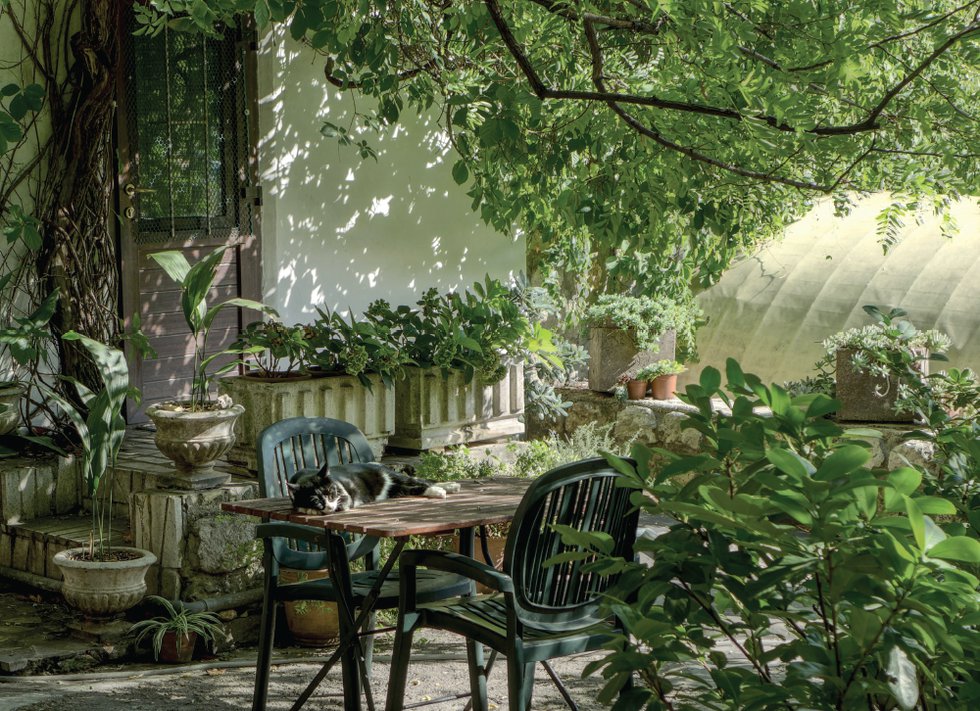
What a glorious time of year in our gardens. Last year’s plantings and pruning, and our early spring feeding and watering, are repaying us with flourishing plants and voluptuous blooms. The hammock and the chaise are calling us; Relax, put your feet up. (Maybe you’re doing so as you read this). Of course, we understand summer also brings heat and humidity, even in our gardens, and on our decks and patios. But let me offer, at least, a partial remedy for summer’s sticky heat. I suggest you apply a bit of magic, a few tricks that may enable you and your family to laze about in the garden even in the heat of July and August. We can take a tip from successful magicians. They distract their audiences, redirecting attention from what is not to be seen—or in our case, felt. 

Here are a few magical distractions

Expand

Garden2.jpg

Shade

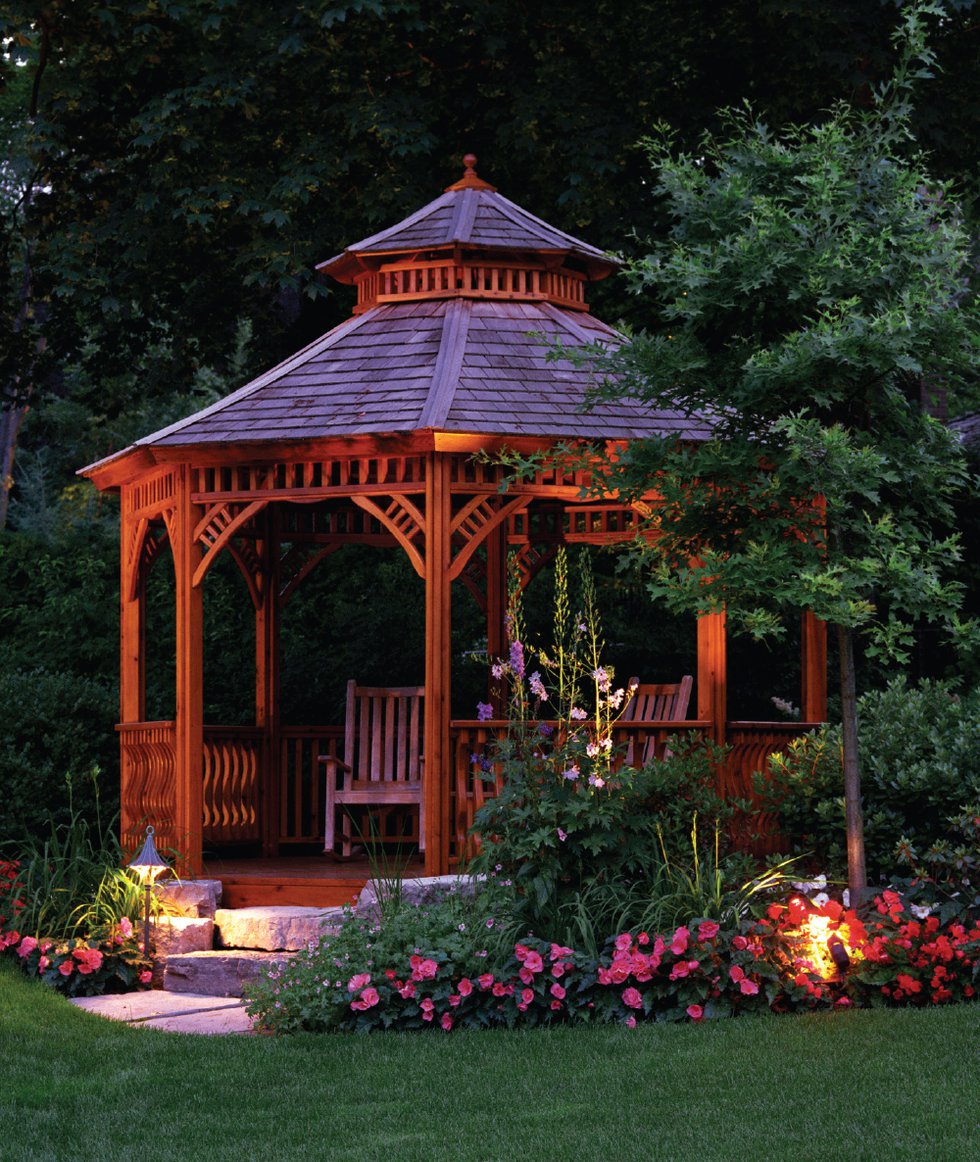
 is an important part of feeling cooler. It may be a little late to plant a shade tree in your garden this summer, but there are other options. Consider how the sun reaches your deck or patio. When do these areas get the most use by you and your guests—morning, midday, sunset? How can you divert attention from the sun’s heat? Perhaps install a pergola or an arbor, depending on how much space you have. A pergola is customarily an arched frame on which vines are trained or plants are hung. You could have one installed right now and for this first summer, rely on hanging plants to create the illusion of vining, while ivy or wisteria or clematis vines are planted and trained for a shady show next summer. The idea is to distract from the heat of the day with visions of green and an impression of a shady glade. If you’d like a more modern, pared-down source of shade, install a shade sail. It can be rectangular or square, and usually white or cream color to reflect the sun. Be sure the sail is securely anchored against the winds of summer storms. One advantage to the shade sail—it can be relocated to provide the best shade. While it won’t evoke a shady glade, it may offer thoughts of sails on the Bay slipping gracefully across the waves. See how quickly our thoughts float away from the heat and humidity? 

Expand

Garden3.jpg

Air Flow 

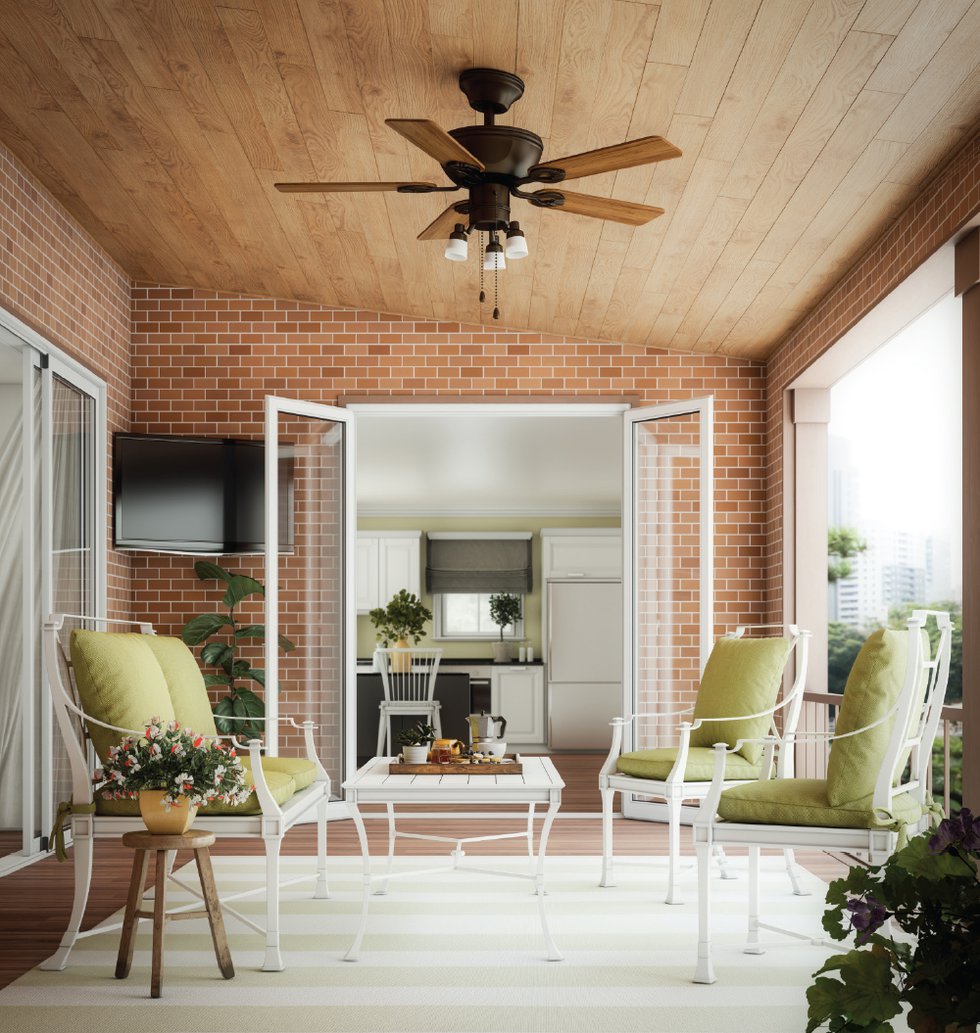
magically distracts us from the weight of Maryland’s humid air. Just think about a gentle breeze across your face and you begin to feel cooler. A few quiet floor and pedestal fans can create that same feeling, working their magic. If you place a low fan among or behind a few potted plants, you’ll hardly notice the artifice. Since you’ll need electricity, think about adding an outdoor outlet or two, if you don’t have one available. Be sure the fans you choose are quiet; it’s difficult to chat or read if there’s a roaring or rumbling motor nearby. Pedestal fans can usually be set to oscillate and setting one or two of these fans to turn slowly along the edge of your seating area works wonders. Not only will the fans provide moving, cooling air, but they will also discourage flies, mosquitoes, and gnats from joining you in your shady retreat. Another little trick: set the fans on simple timers to come on when you’re likely to be on the patio and turn off without your having to think about them. One caution: If you haven’t bought outdoor, waterproof fans, have a few plastic waste bags available to cover the fans if rain is expected. The motors won’t take kindly to being soaked. 

Garden4.jpg

Cool Things 

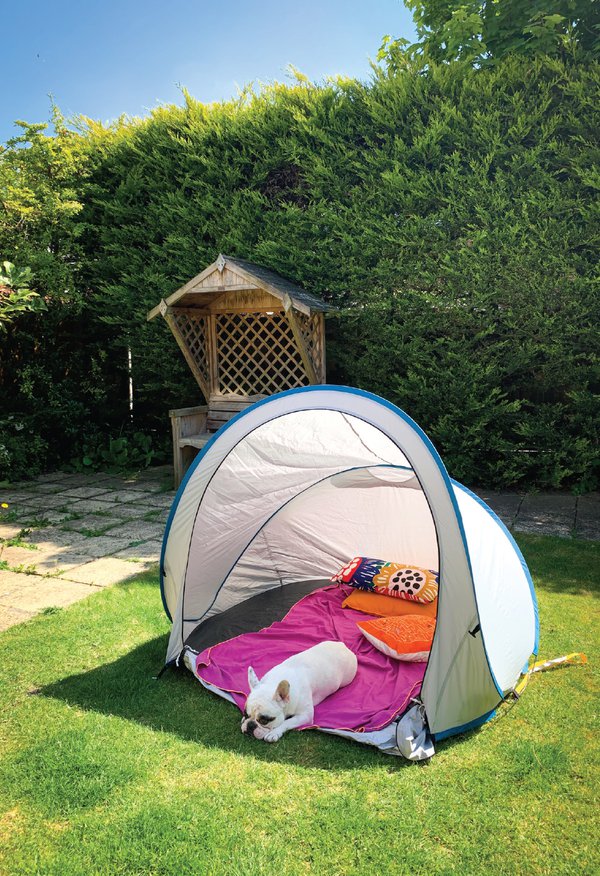
to redirect our body’s thermostats work wonders too. Consider investing in a few pet cooling-mats. You’ll find them on-line and in some pet stores. They’re available in a variety of sizes. The mats are filled with water, air, or gel and absorb body heat while creating a cool feeling. Place them on loungers and chairs and find yourself impervious to summer’s humid heat. Watch out, however, not to sit down on your cat or dog, who might have preempted your use of a cooling mat. Another “cool thing” is a mister or mister-fan. One or several misters can be installed on your deck or patio, camouflaged behind plants or trees, or attached to awnings or roof beams. Misters work by spraying water molecules that change from liquid to gas or mist. I know, you’re probably thinking, Isn’t there already too much humidity? Why add more? The difference with a mister is that the process of turning water drops into mist, a gas, takes energy/heat, which is pulled out of the air, thereby lowering the ambient temperature. There are do-it-yourself kits, but I recommend you get a reliable plumber to install your misters, including the pump to run them. Once properly installed, there’s very little maintenance, and if properly winterized, the misters will continue to work for years. If you’re wondering about the ecological cost, the power to run a mister is far less than what is needed to keep an air conditioner humming. Oh, almost forgot: you can have your misters set up to spray a mixture of water and natural-botanical mosquito repellants, essence of marigold, for example. There’ll be no mosquitos bothering you all summer long—or at least when you use the mister fairly regularly—about 2–3 times per day.

Expand

Garden5.jpg

Water Features 

are a tried-and-true means of distracting us from hot, humid temperatures. We all long for a quiet beach and the sound of waves lapping at our toes. Add a little fountain to your patio; set it up in a shady corner, if possible, and you’ll have songbirds and butterflies as regular guests. You’ll also enjoy the sound of the water as it tumbles down. Small fountains are electric and usually plug in at an ordinary household outlet. Out caution though, you may have to add water daily. If it goes dry, the pump motor can burn out. 

These are just a few simple ways to make your summer garden as delightful as possible. Work your own magic. 

Posted in Nature, Published articles, Uncategorized | 1 Comment

I and my fellow-poets are on “Poets vs. the Pandemic”.

Friends, Thank you for all your encouragement and support of our poetry group. Last evening we read a selection of our poems on the Zoom program, “Poets vs. the Pandemic“. Each poet read four poems. Here is the link to the video on YouTube. The 50 minute program was great fun, and our amazing leader, Maryland’s Poet Laureate Grace Cavalieri had prepared us well for the reading.

I hope you get a chance to watch the program, both ours and others in the “Poets vs. the Pandemic” series. (Feel free to buy extra copies of our anthology, The Song In the Room, available on Amazon. )

Posted in Uncategorized | Leave a comment