December’s column in What’s Up? Magazine

Beautiful Bare Bones:

Reconsidering Our Gardens in Winter

BY JANICE F. BOOTH 

DEC. 06, 2023

garden1.jpg
garden2.jpg

The holidays are upon us, and you’re probably leafing through these pages while waiting to pickup a child at a music lesson or for your turn at the dentist. So, I will be direct: Don’t overlook, during this busy season, the gifts to be enjoyed in the garden—yours and the gardens of others. Let me suggest a relaxation technique that’s foolproof: Consider spending a little time (a) admiring and evaluating your own garden in winter, then (b) visit a public garden or two for ideas and inspiration—a winter garden walk can be a lovely experience to share with friends and family. 

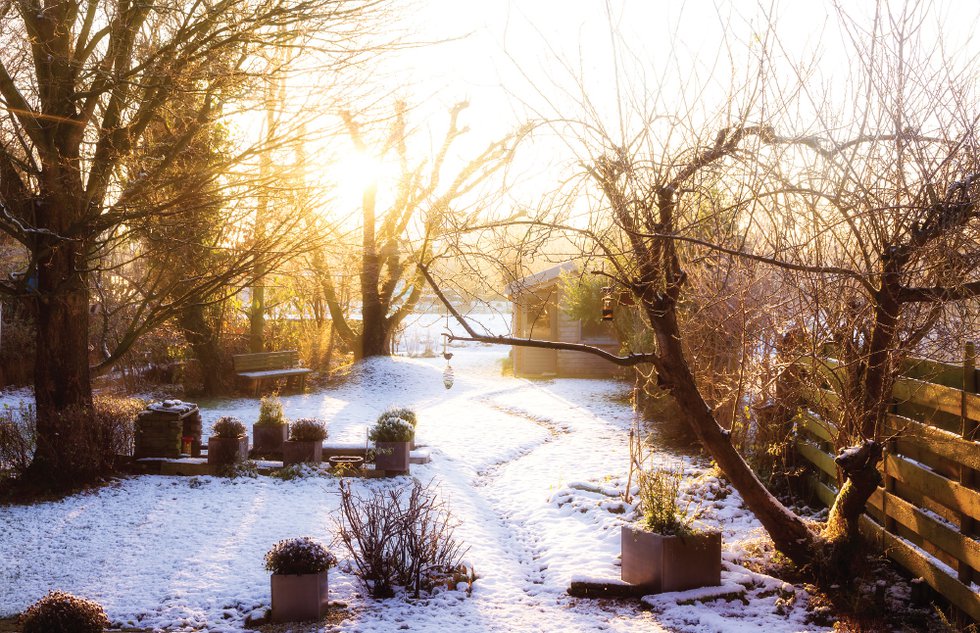
When the leaves and flowers are gone, the garden stands in her starkest beauty. Take a bit of time to admire the architecture of your own garden, no matter the size. Consider:

The skyline is a good place to start. Is there variety in height? 

The smallest garden can create a pretty tableau against the sky at dawn or dusk. Perhaps you’ll want to add a tall, feathery grass to break up the line, or do you need to trim down some shrubs to open a vista. 

If you have a spacious garden, do taller and smaller trees and shrubs create a crenelated view? 

Then there is depth. As you look out across your garden, does it appear, in the words of Robert Frost, “dark and deep?” 

In small gardens, a wandering path can suggest depth, and a carefully placed garden sculpture draws the eye to what appears deeper in the garden. 

Larger gardens more easily exhibit depth, however continuity of depth can be a challenge. Without rivers of blossoms to draw the eye, does the garden hold together moving back and away? Here too, a reconfiguring of your garden’s paths and the addition of a few visual points of interest can lead the eye into more distant areas in the garden. 

Expand

garden4.jpg

Winter’s austerity allows texture to take center stage. The eye will note with interest variety in the textures of bark, branch, and berries.

Bark: Copper, Paper, and River Birches, Sweetgum, Coral Bark Japanese Maple, Cherry Tree all offer beautiful textures.

Branch: Red Twig Dogwood, Corkscrew and Witch Hazel, Oakleaf Hydrangea, False Cypress, and Smokebush provide color all year, particularly welcome among the grays and browns of winter.

Berries: Holly bushes and trees, Winterberry, Firethorn, Beauty Berry, and Chokeberry are popular with the birds and other wildlife that shelter in your neighborhood over the winter. 

Finally, consider whether there are “holes” in your garden, areas where nothing is delighting the eye or striking the imagination.

Which brings us to my second suggestion: Take an hour or perhaps longer and visit a local public garden. Once you’ve evaluated your own garden, you have some questions and ideas that may be answered or enhanced by other gardening professionals. (No need to reinvent the wheel or settle for less than charming ideas.)

Expand

garden3.jpg

Here are some public gardens in Maryland that will probably be open when you wish to visit but be sure by checking their web sites. Plan to take some photos while you’re wandering through the garden. You may also want to take a note pad; you may run into one of the professional gardeners. Ask them any questions you have about your own garden. They’re usually delighted to “talk shop” with a fellow gardener. 

And, we must not forget the spectacular treasures we have within easy driving distance, the National Arboretum (usna.usda.gov) and the National Botanical Gardens (usbg.gov). Both are right down Route 50, and both are free to the public. If you haven’t visited them in a while, please do. 

The Botanical Gardens have a spectacular display of seasonal plants and a huge room with toy trains running among villages, woods, mountains, and rivers all constructed from natural fibers—bark, branches, leaves, heart wood, and more. Open through January 2nd.

Just a little tidbit I ran across in my research: If you’re off to Britain any time soon, the largest and oldest public winter garden is in Regent’s Park, London (royalparks.org.uk/visit/parks/regents-park-primrose-hill). Constructed in 1842–1846, the winter garden is, as you might expect, spectacular—fit for a king or queen!


BY JANICE F. BOOTH

Posted in Nature, Published articles | Leave a comment

“Evidence”

Silk Road Poetry Blog has published my poem, “Evidence” recently. It is an honor to be included in the same posting as Maryland’s 10th Poet Laureate, Grace Cavalieri.

Posted in Poetry, Published articles | Leave a comment

fotospecchio.com, featured poet

I was honored to be the featured poet in the premier issue of FotoSpecchio, an on-line publication featuring photography, poetry, and other artistry. https://fotospecchio.com/poets/janice-f-booth You may also enjoy this month’s featured poet, Gail Bartlett.

Janice F. Booth | FotoSpecchio.com

FOTOSPECCHIO.COM

Janice F. Booth | FotoSpecchio.com

Janice F. Booth is a poet of form. See here the grace, the pantoum, the villanelle, an elegy. Nature is her muse. And the muse is better for it.

Like

Comment

Share

Posted in Poetry, Published articles | Tagged , , , , , | 1 Comment

My review of poetry by Abby Caplin in the Delmarva Review

It is an honor to have reviewed Caplin’s poetry and to be included among these gifted writers.

Posted in Uncategorized | Leave a comment

A Gardener’s Winter’s Tale

Hydroponic Gardening satisfies the green thumb during the coldest spells

What’s Up? Magazine

Another season’s garden put to bed? It’s November; those last roses have shriveled; the mums have dropped their petals; your trowel and gardening gloves are cleaned and stored ’til spring.  

But wait! You can still garden this winter. A hydroponic garden lets you grow fresh vegetables, herbs, and flowers indoors any time of the year. You can set up a hydroponic garden to share with children or grandchildren. Someone with limited mobility might enjoy caring for plants growing indoors on a table or counter during the long winter months. 

Hydroponic gardening is growing plants without using soil—yup, no dirt involved! All you’ll need are seeds, light, water, and nutrients. 

Before you decide to try hydroponic gardening, I’ll give you an idea of what you’re getting into:

  1. Equipment 
  2. Setup 
  3. Maintenance
  4. Pros and Cons 

Expand

Garden2.jpg

Equipment:

There are a variety of systems to choose from if you’re setting this up yourself rather than buying a kit. The types of systems include: Nutrient Film Technique (NFT); Deep Water Culture (DWC); Wick Hydroponics; Flood & Drain System; Drip System; Kratky Method; and the AeroGarden Hydroponic (a popular ready-to-go system). All the equipment can be purchased as kits from various distributors. You’ll need: 

  1. Watertight tank
  2. Tank lid, in which holes can be made to hold plant growing medium
  3. Submersible water pump and tubing 
  4. LED grow lights
  5. Growing medium (a popular type is Hydroton Expanded Clay Pebbles)
  6. Hydroponic nutrients and supplements (types and amounts based on the specific plants)
  7. pH testing meter (you can purchase a liquid kit or test strips instead, but the meter is most reliable) 
  8. Liquid pH Up and pH Down in small quantities for corrections
  9. Seeds (easy, popular choices include leaf lettuce, cherry tomatoes, peppers, herbs, strawberries)

Expand

Garden3.jpg

Setup: 

If you buy a kit, you won’t need to follow all these steps:

  1. Set the seeds in the growth medium. Rooting cubes containing seeds can be set to germinate on a heat mat before being immersed in the hydroponic system.
  2. Setup your watertight tank: a. Avoid placement near bright sunlit windows. b. Avoid areas that are too warm, too cool, or drafty. c. Be sure there’s enough room for the plants to grow up. (usually 12–15 inches) d. Keep in mind that water may splash out of your tank. Be sure to protect any vulnerable surface, such as wood or fabric.
  3. Install an LED grow light, full spectrum. Be sure the light’s coverage area matches the tank’s surface area.
  4. Mix nutrients and supplements with water: a. Wait 15 minutes after mixing, then test for pH level. b. Adjust solution for a balanced pH level (Important to know your plant’s pH requirements)
  5. Set grow light on a timer (usually 15 hours of light per day) 
  6. Test your system for leaks. 

You’ll usually see sprouting within one to three weeks. 

Expand

Garden4.jpg

Maintenance: 

Once the seeds begin to sprout, your work commences in earnest. This is not a project that allows you to go away for two weeks and come back to a happy garden tank. Nope. Rather, there’s a daily routine while your hydroponic garden is flourishing:

  1. Check that the grow light is set for the appropriate number of hours and working. (LED bulbs can last 5 years, so you’ll probably not have a problem.)
  2. Check the water level in the tank. Is there sufficient water for the pump to work effectively?  
  3. Add nutrients and supplements needed by your plants’ roots. Usually, the seed packet will give you this information.
  4. Check the pH level of the water after the nutrients are in. Add pH Up or pH Down, as needed.
  5. As the plants grow and leaf out, you may need to trim or harvest leaves around the outside of the plants to allow growing room, and open up the place where you add water and nutrients. 
  6. Harvest! Enjoy those sweet, little cherry tomatoes on a bed of red and green leaf lettuce. Perhaps you can even sprinkle the salad with basil or oregano. All from your own tiny garden. 

Expand

Garden5.jpg

Pros and Cons:

The Good News: 

  • Hydroponic gardening is fun, particularly if you’re sharing the hobby or project with someone else. You’re cheering on the little sprouts and plucking the ripe fruit or veggie together. 
  • If you really enjoy hydroponic gardening, you can try more exotic plants like peppers, cucumbers, eggplant, and celery. And, you can keep your indoor garden going all year long.

The Not-So-Good News:

  • Hydroponic gardening can be expensive. You’ll take several grow cycles to make up the equipment costs on the vegetables you consume. 
  • Plants live an average of 3–4 months before they’re done producing. (Sometimes less.)
  • Your indoor garden needs attention every day, if only to confirm that it has enough water and nutrients. There’s no going away for a few weeks and leaving the lettuce to fend for itself. As the plants grow larger, they require more and more water and supplements. 
  • Finally, just like in your outdoor garden, your indoor garden may attract bugs. I have never figured out how those annoying fruit flies appear; so, I don’t know where the bugs might come from, but they do…sometimes.

If you decide to try your hand at hydroponic gardening, you’ll have some interesting experiences, no doubt. Take some pictures along the way; include a little card saying how many days old and what type of veggie. It’ll be fun, maybe even a little photo collage of your new hobby and its successes. 

BY JANICE F. BOOTH

NOV. 2023

Posted in Published articles, Uncategorized | 1 Comment