I’ve really tried to get along…

After a recent aborted trip to Assateague Wildlife Refuge in Virginia, where mosquitoes both large and small drove us from the ponds and sea-shore,  I sat down to discover a way to make peace with the ruthless insects that swarmed over us on that tiny slice of Eden on the mid-Atlantic coastline.

I took to my computer with the intent of learning something redeeming about mosquitoes.  Really I did!  I thought there must be some value to these blood suckers.  https://open-line.org/wp-content/uploads/2012/09/mosquitos2.jpg?w=297

But, I’ve found none – NONE I say! They serve no constructive purpose in the ecosystem.

Even the bats and purple martin that kindly gobble these nasty critters will be fine without a mosquito entrée.

You may be able to predict what comes next… my diatribe against the vicious, ubiquitous mosquito! (Of the phylum Arthropoda, class Insecta, order Diptera, family Culicidae, according to the Columbia Encyclopedia.)

Mosquitoes don’t help the flowers or the trees; they don’t provide any worthwhile service that I can discover – except, perhaps, the task of keeping those of us who are wimps out of the wild, leaving us cowering on screened porches or swathed in specially treated, loose fitting, mosquito repellent clothing.

This is a photo of my personal enemy extraordinaire – the Asian Tiger mosquito This ruthless pest arrived in the US around 1985 and has no plans to depart. What makes the Tiger mosquito particularly despicable is that, unlike other breeds that bite mainly at dawn and dusk, the female Tiger mosquito will attack anytime of the day.  She seems to know no limits or understand the daylight-hours truce set up between humans and mosquitoes somewhere in the dim past.

There is nothing amazing about these nasty gals – yes, I said females.  The male mosquito does not bite; he’s innocent of my wrath.

Are these insolent insects so wily and quick that they outmaneuver humans at every turn?  No! Mosquitoes don’t move quickly – about 1 mph; they don’t live long – about 2 weeks. They don’t travel far – remaining within a city block of where they hatched, and they’re fairly stupid, perhaps “single-minded” would be a kinder description, but I’m in no mood to be kind.

So why are humans assailed on every side? sickened and intimidated by these small harpies? Why are they giving me sleepless nights, itchy welts, and an attitude that won’t quit?

Historically, the US Department of Agriculture, Division of Etymology  has been waging war against mosquitoes, lice and bed bugs since the latter half of the 19th century – you guessed it, the Civil War.  By World War I the USDA was hard at work searching for reliable methods of winning the battle of the bugs that plagued the armed forces.  By World War II, DDT (DEET) was available and popular – and, as we later learned dangerous to EVERY living thing, plant. animal and insect.

In the early 1960s, Dr. Edward Kripling, the head of the USDA, Div. of Etymology, and author Rachel Carson were uncovering the same disturbing evidence; after less than 30 years of use, DEET was destroying all life forms indiscriminately. Her seminal work, Silent Spring echoed the policy changes Dr. Kripling was instituting within the USDA – stop the dogged application of DEET.  Both Carson and Kripling urged the expansion of bio-control techniques in the struggle with destructive insects – pests.

  Which brings me to my “call to arms”! (Yes, picture me with flame & trumpet here.)

I know we all have an assortment of bug-repellant lotions and sprays in our drawers and backpacks, but I propose we take up spades and garden gloves to expand our defenses against these ruthless Amazons of the insect world.

There are five pretty plants that seem to particularly annoy mosquitoes.  I intend to head out to the nursery next spring and buy as many as I can afford.  I’ll plant these cuties around my house and along my walkways!  My garden will become a veritable jungle of smells that make those mosquitoes wince.  (Gotcha!)

The five weapon war-plants are:

  1. Catnip:  Catnip These hardy, weedy plants aren’t pretty, but they will do the trick. And, my kitties will love it.  They’ll be drunk as skunks all summer long.
  2. Flossflowers: Also called Ageretum. AgeratumThese pretty purple blossoms and hardy plants need little attention.  And, you can crush the leaves and rub them on your skin for added protection.
  3. Marigolds:   MarigoldsCheery, hardy and easy to grow from seed – they’re cheap protection and great in flower boxes.
  4. Beebalm: Also called Horsemint.  HorsemintAnother cheap solution. Get a plant from a friend, and by next fall you’ll be able to pass on lots of plants from this easily-divided, hardy helper.  Beebalm is popular with bees as well as unpopular with mosquitoes, an added bonus.
  5. CitronellaCitronellaThis elegant. decorative grass tends to be a bit too hardy. You may want to plant it in pots to help control spreading.  Also, pots are nice for moving about, should you find a favorite seating for your lawn chairs and require extra mosquito protection.  (Suggestions taken from http://www.eartheasy.com  )

These babies are cheap and hardy – qualities not unlike their arch enemy and mine – the female mosquito!  So, join me.  Plant away! We’ll pound out swords into spades and give those Culicidae a snoot full.

Thus begins my campaign of retribution – mosquitoes, beware!

Posted in Nature, Uncategorized | 7 Comments

Thanks giving…

Cooler evenings, sweeter breezes, a kinder sun… autumn arrives. My favorite season. September and October always quicken my heart and fill me with energy – plans for new projects, renewed interest in old ones.


For most of my life, autumn meant the return to the classroom, first as student for 18 years, and then for 30 years as public school  teacher. With fall’s refreshing weather came new students and classes, new challenges and problems to solve.  I associate fall with new names, new skills and new facts, new books and new challenges.

I love the rush and bustle that seems to bloom in autumn like ripe apples – crisp, juicy and slightly tart.  Summer travels seem merely a warm up for the real adventure and journey that fall sets before me. Can I find my way? Will I understand what I’m asked to do? 

I look out at the garden and know this is the perfect time to listen to the world  – the rustling leaves and bubbling water, the perfect time to watch the sunlight dapple the grass, to feel the cool, autumn air.

An aura of  energy and possibility seems to quicken my spirits in the fall. There’s not a moment to waste, there’s so much to learn and accomplish.

Recently, I came upon a poem by Paul Laurence Dunbar, “Merry Autumn.”  The poem’s folksy tone matches my own response to fall’s arrival.   Dunbar’s celebration is joyous and affirming.  Here are the last stanzas…

Don’t talk to me of solemn days
In autumn’s time of splendor,
Because the sun shows fewer rays,
And these grow slant and slender.

Why, it’s the climax of the year,—
The highest time of living!—
Till naturally its bursting cheer
Just melts into Thanksgiving.

Continue reading

Posted in Life Lessons, Poetry, Uncategorized | Tagged , | 3 Comments

Crofton Library Talk

September 18, 7pm  – speaking at the Crofton Library

Jan Booth –  Tuesday, September 18 at 7 pm

On the 10th anniversary of the opening of the Crofton branch, Jan Booth, the author of the book Crofton,an Images of America book will discussthe history of Crofton and talk about the images selected for her book. There will be time for questions as well as light refreshments.

For all ages

Posted in Uncategorized | Leave a comment

A Stitch… In Time

Yes, here I go again… reminiscing.  This time I have a few thoughts on sewing, that waning art and craft. Now, sewing is a fairly general term. What I want to comment on is not hand sewing, which includes fancy stitching and quilting. (Actually, Bartlett’s lists 21 types of sewing.) I want to talk about the most practical form, sewing garments by machine.

Let me begin in the days of old, when girls were sweet and boys were bold…  No, no; I’m getting off track here. I mean the middle of the 20th Century when girls were still encouraged to master patience and quiet resolve under the watchful eyes of moms who were, very often, models of patience and parsimony.

The elder seamstress in our family was my maternal grandmother, Effie.  She’d been taught hand-sewing by her mother, a seamstress; thousands-and-thousands of fine, even, nearly-invisible dashes of thread through fabric –  and Effie was not fond of the work.

As a wife and mother of four, my grandmother acquired a treadle sewing machine. The picture above is of a machine similar to  my grandmother’s – with a fine, varnished wood case, fancy wrought-iron treadle and shiny, black machine trimmed lavishly with gold-leaf designs.  A magnificent furnishing for the parlor and an essential tool for the homemaker.

The invention of the family sewing machine was tied to supply and demand. Wildly productive weaving mills produced vast quantities of fabric. Markets were needed to absorb the supply.  Huge, industrial sewing machines turned out serviceable garments that dressed the nation. But some entrepreneurs saw a significant, untapped market – the homemaker. Until the 20th Century, homemakers hand-stitched trousers and skirts, blouses and shirts for everyday use. Such painstakingly produced garments were not tossed aside blithely. They were used and passed-down through families.  Unless you were quite wealthy, only special occasions warranted the purchase of a garment from the Sears catalog or the dry goods store.  Easier production of family clothing might mean more family clothing – and it did.

In her book about the history of the sewing machine, Grace Rogers Cooper recounts the work of inventor-machinists Nathaniel Wheeler and A.B. Wilson. They devised a small sewing machine that could produce single garments. Then, around 1870, Isaac Singer envisioned how to market that little sewing machine as a “family machine.”  Women were savvy early-adopters, why not an easy way to clothe their families? American homemakers were embracing washing machines, ice boxes and gas lights, work-reducing,inexpensive, modern conveniences. Here was one more practical investment for the family, a sewing machine.

Singer tapped into this enthusiasm for work-saving machines.  By 1905, the “Singer” was in great demand. His treadle sewing machine was a moderately priced, reliable workhorse, outfitted  in discreetly splendid attire. What homemaker could resist?

My mother, Mabel, was a deft seamstress; sewing was an outlet for her technical and artistic aptitudes.  Mom taught her daughters to sew first by hand, and eventually on her Singer electric machine in its mahogany cabinet.   Like many girls of our generation, my sister and I began with doll clothes – cutting out our patterns from newspaper, choosing fabric scraps from Mom’s box of odds-and-ends, then cutting, hand-stitching and fitting the fashions to our baby dolls or bride dolls. (No Barbie Dolls then.)

Making doll’s clothes taught me how the elements of a pattern worked – the darts for fitting, the seams and hems, the necklines and sleeves.  All these components have their tricks, the way they must be joined with the other parts of the garments if the dress or jacket is to fit the doll.

On her sewing machine Mom turned out dresses, jackets and suits for herself and her daughters, and even shirts for our dad. Mom had a seamstress’s eye for the right fabric, the best pattern, and how to “fix” garments when they began to wear.  She taught me how to look at a picture in a catalog and figure out what fabric I could buy and what pattern I should choose to create my dream dress.

At the fabric store we poured over the Butterick and McCalls pattern books.  With each project Mom taught me a new skill. I learned the complexities of French seams, pleating, matching fabric patterns, covered buttons, tailored button-holes, reversible garments.  I learned to sew on silk and nylon, terry cloth, corduroy and velvet – all very tricky fabrics that required just the right touch if one wants smooth seams and graceful draping.

For me, the ultimate test of my handiwork was if no one asked me, “Did you make that yourself?”  That question was the “kiss of death”.

Recently, I’ve surveyed friends of my generation, and women a decade or two younger.  Many of them learned to sew as I did.  Friends from working class and middle class families learned the practical skills associated with the sewing machine.  Friends raised in more affluent homes bought sweater sets and pleated skirts at the shops downtown. We all learned the lady’s accomplishment, decorative stitchery – embroidery, crocheting and knitting, no matter what our social standing.

I wonder if sewing machines might regain their prominence in the homes of working families?  (I still have one that I use for mending and making slipcovers.)  As families choose, or circumstances force them to make do with less,  a stay-at-home parent might reintroduce sewing as a skill worth mastering.  4127_051909_sundress.jpg

If we have more time and less money, there may be an expanding interest in not only gardening and crafts but in the do-it-yourself of fashion – sewing your own clothes.  A small but dedicated segment of women  continue to sew cloths, curtains, slipcovers and Halloween costumes. Will their numbers grow?

A silver lining to necessity may be teaching ourselves and our children to sew, thereby encouraging self-reliance, patience, attention to detail, aesthetics – all valuable qualities fostered by sewing

sewing at the dining room tableRosie Grier and Martha Stewart, here’s your next new thing!

Posted in Life Lessons | Tagged , , , , , | 1 Comment

The Grand Old Osprey

OspreyThey’ve enjoyed 11 years in their little nest with a harbor view, through good times and bad – Hurricane Isabel in 2003, the hatching and departure of all those dear chicks over the years, the surveillance caper in 2010.  They’re a couple who’ve weathered adversity, together.

Choosing their mates when they’re around 3 years old, osprey usually begin breeding when they’re 5. That makes my friends, Opal and Oscar, at least 14 and perhaps 16 years old. (Osprey usually live to be 25 years old.)  The strength of a mating pair depends primarily on feeding – how well they feed one another, and how well the male feeds the nesting female and their chicks.  Male osprey are noted for eating only the head and tail of a fish, saving the nutritious mid-portion to feed the nesting female and chicks.

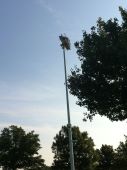
Oscar and Opal are a devoted pair.  I watched them build their original nest in 2001. (I’ve been walking the Naval Academy almost every morning since my retirement in 2000.) They chose a perfect location – the farthest lightpost at the outer-most point of the Academy grounds. Opal and Oscar knew what they were doing.  From their living room, they have views up and down the Severn River, out into the Chesapeake Bay and across the Annapolis harbor all the way to Spa Creek.  The football practice field gives them an unobstructed view of any approaching predators or threats to their fledglings.

Almost any threats, that is…

Back in September, 2003, my osprey friends, and all of us in Annapolis were surprised by Hurricane Isabel.  She devastated the Bay coastline, tearing up trees and producing flood waters 10 feet deep or more along the Bay’s shores.  The Academy was flooded above the first floor in dorms and classroom buildings. And, Oscar and Opal’s  nest was badly damaged, though not destroyed. I feared they may have lost their lives.

But, before two weeks had passed, the osprey were back!  At first they tried restoring their nest, but eventually, they gave up and simply built a new nest atop the original.  Before long they had a two-story home!

Life went on for us all…

And then another threat –  In 2010, the Naval Academy began installing security cameras around the perimeter of the Yard. That meant a camera was to be installed on Oscar and Opal’s lightpost!  It was winter, and the couple had joined the general Florida migration of birds and people to Florida for a well-deserved winter vacation.

Back at the Academy, a great truck deposited an huge “cherry picker” vehicle beneath the vacant nest site.  Men in harnesses rode the cherry picker’s “nest” up, up, up, and the electricians  installed a camera next to the nest.

But there was more. A large, plastic owl was secured beside the camera, in front of the nest!  Were they worried that the nest needed protection while Opal and Oscar were away?  No… Did they think this fake owl would scare away our intrepid osprey?  Really? This is the osprey couple who had faced down Hurricane Isabel. Intimidated by a plastic owl? Hardly!

In the spring I waited anxiously to see what would happen.  And then I heard them, that distinctive osprey sharp, high-pitched call that echoes like sonar off buildings and water surfaces. They soared in from the south, over the football field and… yes, settled their graceful, powerful wings on the lightpost adjacent to theirs.

From next door they checked out the new additions to their property – the camera and plastic predator. And, for a few days I saw them swoop and swerve over the foolish owl, whose plastic head revolved a little to the right, then a little to the left.

Once the osprey had determined the invaders were harmless, Opal and Oscar went back to tidying up their nest, laying eggs, hatching and feeding their young and sending those fledglings out into the world. (Some years this prolific couple has produced two clutches of eggs.)

And now, 2012, the machines have come again: great semi, spewing diesel fumes and noise, cherry picker with long, threatening claw-arm, men with noisy tools.  The camera has been removed from the lightpost. (Though the foolish owl remains.)

But now, in the prime of their breeding life together, Opal and Oscar seem to be fed up with the hassles at home.  They’re moving!

Over the past weeks, the couple has been building a new nest!  Perhaps they’re going for something a bit smaller? more modern? easier to maintain?  I’m not sure. But mornings now I watch them feather their nest with fresh Bay grasses, new twigs, bits of bark – all the components that will make them feel quite at home.

They’ve still got their view – after all, they’ve only moved 20 yards further down the yard. No camera humming, no silly owl peering at them night-and-day. Opal can add all those little niceties she’s seen in friends’ nests, and Oscar can stop worrying about that first floor mess that was the foundation of their former home.

And, the U.S.Naval Academy has given them a wonderful housewarming gift – or I think they have. After conversations with the Academy’s Office of Environmental Issues, they’re taking Opal and Oscar under their wings – in a manner of speaking. They’re going to look after the nests – both old and new, just in case the couple decides to move back to the homestead.  It seems the osprey share many qualities of a fine sailor and officer – tenacity, wisdom, expertise, loyalty and stewardship.

I’ll keep an eye on them too, just in case…       A distant view of the U.S. Naval Academy from ...

Posted in Adventures, Life Lessons, Uncategorized | Tagged , , , , | 1 Comment